

The Claims
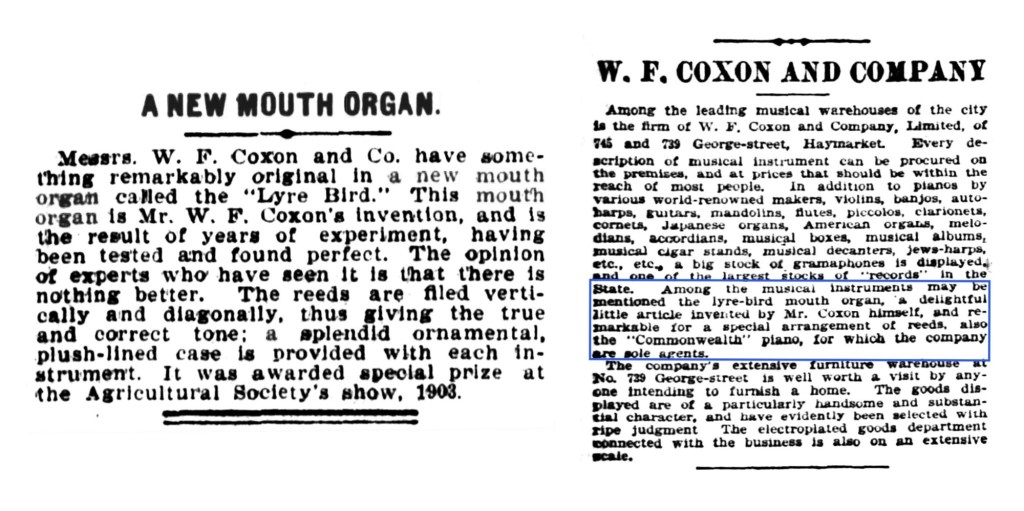
Mr. W. F. Coxon’s invention.
Result of years of experiment, having been tested and found perfect.
The opinion of experts who have seen it is that there is nothing better.
The reeds are filed vertically and diagonally, thus giving the true and correct tone.
Remarkable for a special arrangement of reeds.
There is nothing to suggest that this mouth organ is extraordinary or that William Frederick Coxon of Australia was the inventor. His company traded as importers, merchants and furniture manufacturers. The fact that the Lyre Bird mouth organ was imported from one of the biggest German manufacturers implies otherwise. Perhaps it was William’s idea for the name and design on the cover.

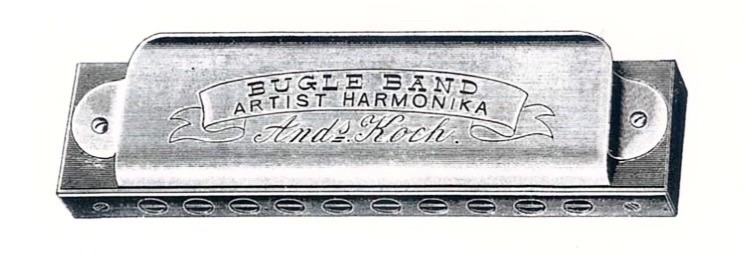
It most certainly was (Ollie) manufactured by Andreas Koch of Trossingen, Germany, and one would suggest the inventor or designer of this particular mouth organ. He had other models with the same mouthpiece in the 1908 catalogue.
Champions on Lyre Bird Mouth Organs
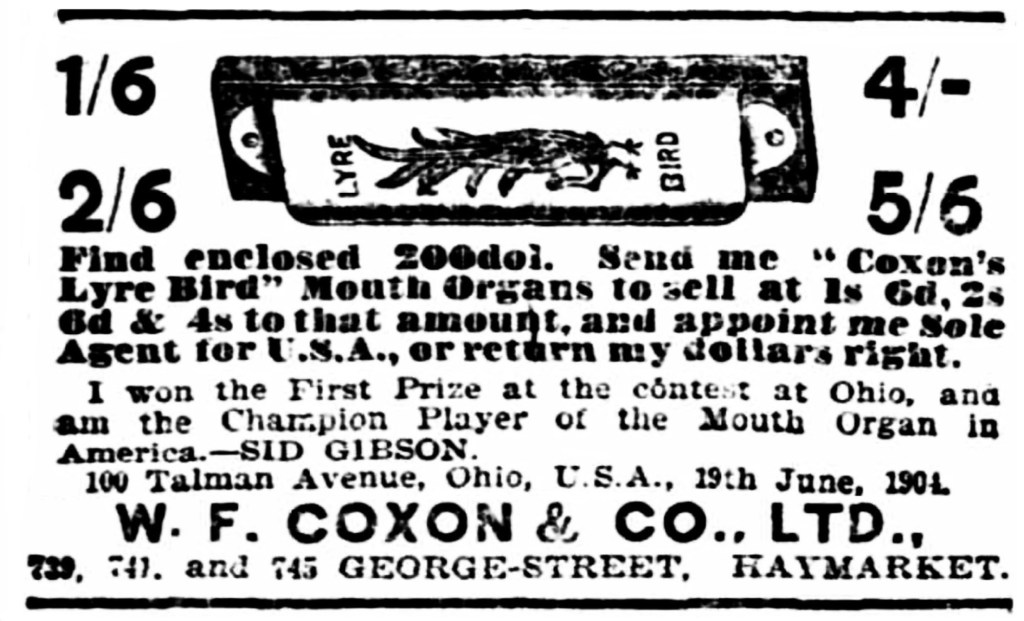
Over to Pat for this one. “I like the way the address fails to give a town or city! No ‘Talman Avenue’ that I can find in Ohio. There is a ‘Tallman Avenue’ in Bellaire, which is a couple of hundred miles northwest of here, but despite access to a lot of Ohio genealogical stuff, I can’t find a Sid or Sidney Gibson from that area. I also can’t find any mention of an Ohio harmonica contest from around the turn of the century.” Anyone know of Sid Gibson and/or does anyone in the States have a Lyre Bird mouth organ sourced from within?

Appears that Thomas McHenery and A. J. Stollery did win a competition using said brand, however one might be of the mistaken belief from the advertisement’s declaration is that the winner defeated other contenders who were playing a different brand of mouth organ. The champion (to use the term loosely) was always going to be someone performing on the Lyre Bird as the following article attests.
Last night, in the Oddfellows’ Hall Lower Church-street, a mouth organ contest was conducted, the instruments used being Coxon’s lyrebird mouth organs. There was a fair attendance and the audience expressed appreciation of the efforts of the players. There were nine contestants, and each exhitbited much skill in evolving music from the small instruments. In the first round A. J. Stollery, W. Ferrer, and Edward Parkes were each awarded 50 points. In the second round Stollery, who played splendidly, was placed first with 55 points, total 105 ; Ferrer second, 50 points, total 100; and Parkes third with 45 points, total 95.. The first prize was a silver cup, the second a silver watch, and the third an accordion. They were awarded by W F Coxon and Co. Ltd.
(Newcastle Morning Herald and Miners’ Advocate Sat 24 Dec 1904)

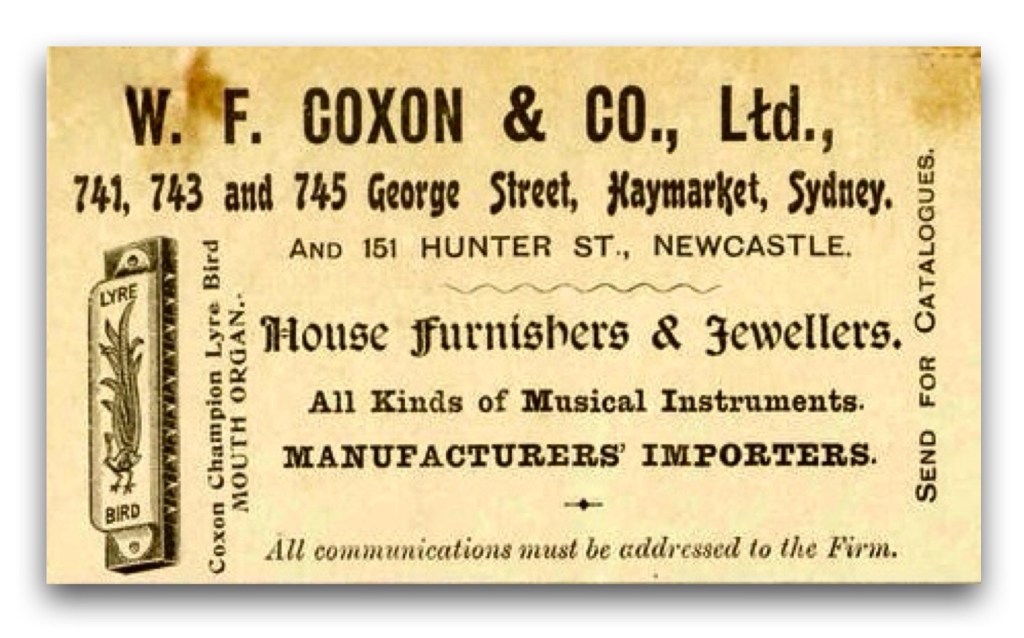
Another Lyre Bird

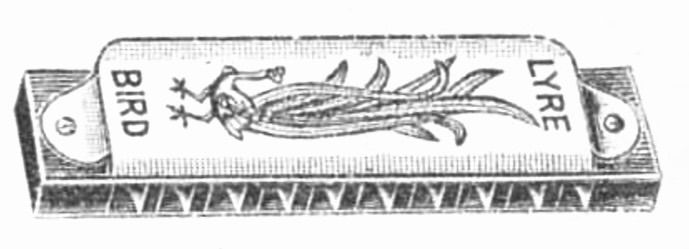
Interestingly, but not very funny Hohner advertised an Advance Australia model with a similar (slightly different) image of a Lyre Bird. Perhaps it’s the same source image, but a slightly different engraving or stamping process.
Three different Lyre Birds

Do yourself a service and check out the first Lyre Bird (and Magpie) article Mouth Harp Mimicry.
The Real Thing (Come and See)
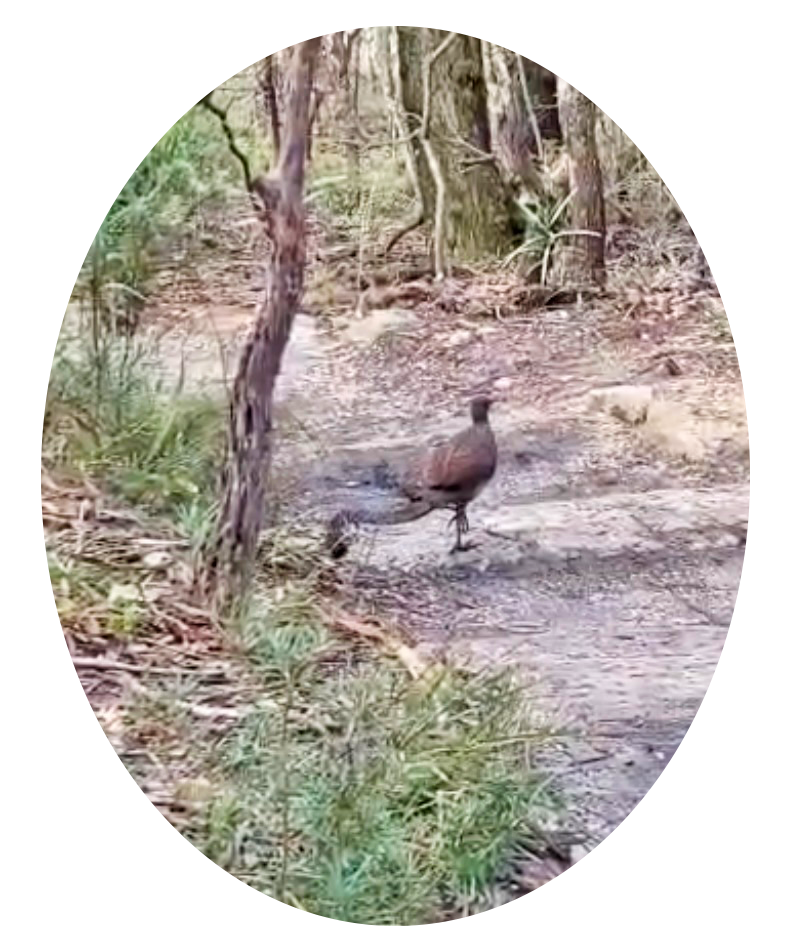


Great write up Shep. Maybe the different companies using the Lyre bird emblem is their way of saying their harps are unique and do not sound the same as and are superior to their competitors. The Lyre bird does seem to have an amazing catalogue of various mimicry sounds. Very superior to other birds re: vocal abilities. Cheers Shep. 🙏🏽🍁🍂.
LikeLiked by 1 person
Thanks Gray. Yeah sounds like they’ve mimicked a fast speed camera shutter. 🐾🐾
LikeLike