

Cobber: Australian and New Zealand informal – a friend/mate (male). Word origin: from dialect cob to take a liking to someone
Source: Collins English Dictionary.

Bauer & Krause
Here I go again off to find the maker of the Aussie Cobber mouth organ sold exclusively by Jackson & MacDonald of Druitt Street, Sydney.
We had already established it had been trademarked in 1911 and distributed to the lucky country by Bauer & Krause in 1912, but as they were importers/exporters they would have outsourced the manufacturing.
Back in 2018 the journey had begun with Cobber & Co .

Cobber Tin

As we have no physical specimens (at the time of drafting), the two tin cases that do exist, Doug Dawson’s 20 reed model (in immaculate condition) and the Ol’ Shep Dawg Hisself’s 40 reed model (in not so immaculate condition) will have to suffice. As Doug is one of the world’s big collectors, I wondered if it might be possible to narrow down the maker on the structure of the tin container. I understand these would have probably been outsourced by the manufacturer, but why not put them under the microscope? Of course it was a long shot and not likely to be the smoking gun.


One of the first suspects investigated would be F A Bohm as their harps were often sold with metal housings. The popular Violin King model was one such culprit. Doug’s eagle eye and measuring stick determined both the Cobber and F A Bohm tins were of similar structure and size.


I asked Doug to check the Crackajack’s as they were sold in metal containers. His response, “I have a Crackajack in a tin and had a good look at the tin. It is quite different in size than the Bohm tins I have. Much deeper tin that seems to be made from a cheaper material.”


Then I thought I’d have a closer squiz at the superb graphic on the cover of the Cobber tin – surely (don’t call me Shirley) it’s a reproduction of what came within. However, just to confuse things, an advertised Professional Cobber leaflet wrapper (displayed below) had the pictured mouth organ with a different cover plate to the graphic represented on the tin.
Cobber Wax Leaflet

The rounded corners and full cover plate seen in the leaflet is similar to the Violin King and according to Pat Missin the ‘Bell Metal Reeds’ boast was popular on F A Bohm models – their Hero models being an example. Hohner too used the phrase on their famous Echo models.

Let’s have a gander through the catalogues for kindred models of the tins mouth organ graphic which has the smaller rounded ends to the cover plate.

Hohner’s 1912 Up To Date and Chromatica cover plates were similar and in the same year they were producing the Hohner Band in metal boxes. Guru Pat (Pat Missin) felt, “There is some similarity between those and the picture on the “Cobber” tin, but it’s a fairly common cover shape for Knittlinger-style harps. It could just be a coincidence. The Hohner tins don’t look too much like the “Cobber” tin.” Previously Pat confirmed that he, “wouldn’t be too surprised that this (the Cobber) was one of F A Bohms.”


F A Bohm?
No conclusive proof, but F A Bohm a definite, probably, maybe, could be. Yeah nah! In my previous article on the Cobber I referred to a conversation I had with young gun harmonica player Eddy Boyle, in that he may have had one in his collection. I gave him a tingle, but alas he does not. There appears to be no specimens out there.

Cobber Mouth Organ Exists!
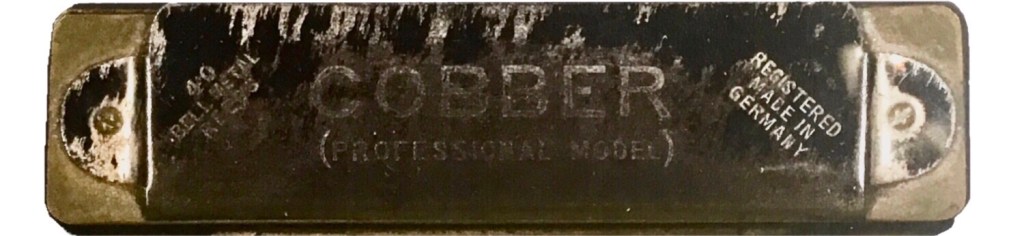

Then from nowhere, prominent world collector Harland Crain informs me he has one and the harmonica has a cover plate identical to the graphic on the tin. You bloody beauty! Harland also informs me that both Cobber cover plates are identical.

F A Rauner?

Sadly still no definitive proof to the maker, but I’m leaning towards F A Rauner because of the similarities to my my Crackajack Concert (F A Rauner) – the 40 Bell Metal Reeds set at a 45 degree angle to the left of the cover plate and the mouth organ model being bracketed under the brand moniker. Pictured previous is Harland’s Cobber pictured alongside my Crackajack Concert. What ya reckon?
Otto Weidlich?

Recently Pat Missin had discovered a batch of new (old) trademarks which shed light on the manufacture of some antique Aussie brand harps.
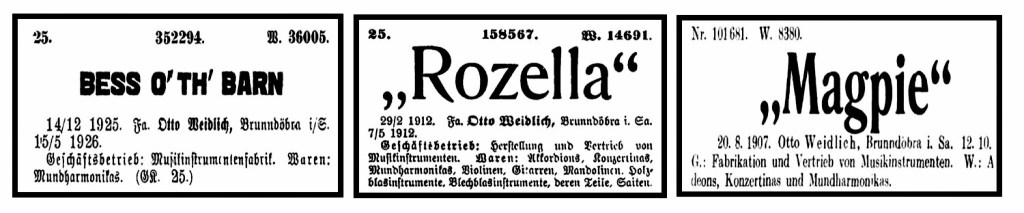
Otto Weidlich had a big play Down Under with the Bess O’ Th’ Barn, Rozella and the Magpie. Otto’s Bess O’ Th’ Barn model (originally thought to be F A Bohms) also professes Bell Metal Reeds.

So could the Cobber be his? I contacted the guru on his take of the recent investigation, “There are definitely some similarities between the Cobber and that Crackajack, so it could be a Rauner. That said, I also wouldn’t be surprised if it turned out to be a Weidlich. I can’t see anything that’s making me favour one over another.”

Still searching for the nugget that provides ‘beyond reasonable doubt’ evidence for the identity of the maker. Pat has a new batch of TM’s to sift through so I wait patiently (😂). Help me if you can I’m feeling down.
Cobb & Co
For those not aware of why the title Cobber Coach here’s a wee Australiana history lesson. On the 31st of January 1854, The Argus newspaper of Melbourne ran an advertisement from Cobb & Co. under the header, ‘American Telegraph Line of Coaches’, that announced to the public, “Daily communication between Melbourne, Forest Creek and Bendigo. Cobb & Co. have determined to run a line of well appointed Coaches between the above places starting from the Criterion Hotel every morning (Sunday excepted) at 6 o’clock and from Forest Creek daily at the same hour.” The first coach had already departed the previous day. Aligning itself with the Gold fervour of the day, Cobb & Co. was the brainchild of four Americans; Freeman Cobb and his partners, Murray Peck, John Lamben and James Swanston, each of whom had been associated with Wells Fargo, Adam’s & Co and Ben Hallidays. The Forest Creek (Castlemaine) line operated from the Victorian Goldfields linking them to the young, expanding Melbourne town. Mail contracts were awarded and from there they never looked back.

Cobb & Co. had imported American Concord Coaches and were known by the locals as the ‘Yankee’ coaches. They differed from their English counterparts that had operated in the colonies. Instead of a metal spring suspension, the body of the Cobb and Co. Coach was slung on thick leather springs that stretched over the entire space between the front and back wheels. This ensured a more adaptable Coach for the rough terrain and provided a more comfortable ride. They weren’t cheap costing a princely sum of £600. Another newly arrived American, businessman George Train helped finance the importation of several of these American coaches.

Part of Cobb & Co’s success was the frequency of replacement stations set every ten to twenty miles where fresh horses would maintain a speedy (about seven miles an hour) arrival. Two years later Cobb & Co. was sold for a nice profit and Freeman would return to his homeland. The new man at the helm after a couple of quick sales was the rough and ready James Rutherford, who established the firm’s stronghold by expanding into New South Wales. Cobb & Co. operated for seventy one years and played an important role in the development of vast areas of the outback. At its peak, Cobb & Co. Coaches travelled 44,800 kilometres a week and 6,000 of their 30,000 horses were harnessed everyday.
Glenrowan
Cobb & Co. were part of Australian folklore and often their heroics were portrayed in the art, literature and music of the day.

One such man to do so in poetic form was William Ogilvie, who left his hometown of Kelso, Scotland as nineteen year old in 1899 to experience life on the land ‘Down Under’. Initially he worked as a Jackaroo on horseback at a Sheep Station at the back of Bourke (NSW). From there he progressed to; cattle droving, a shearing shed overseer, a horse breaker and a station hand both in South Australia and New South Wales. He wrote prolifically of his outback experiences and in 1894 he sent his poem Beyond the Barrier to the Sydney newspaper The Bulletin and was dually published. Penned under the moniker of Glenrowan he would write many more including the Cobb & Co. poem. Two years later, inspired perhaps by Will’s, Henry Lawson composed The Lights of Cobb & Co. In 1898 William’s first book Fair Girls and Gray Horses was published exalting him into the glorified company of bush balladeers, Banjo Patterson and Henry Lawson. In 1901, after twelve years in Australia, Will returned home to the Scottish Borders. Australia’s loss.
By North and South, and East and West,
Cobb & Co by Glenrowan (William Ogilvie) – From The Bulletin 1895 (1st stanza)
By dawn and dark and day,
By swamp and plain and mountain creek
They take the foremost way;
And where the slanting sun-rays dip
And underneath the stars
Is heard the thunder of the whip
And creaking of the bars;
And out beyond the reach of rail
As far as wheel-tracks go
The drovers round their camp-fire hail
The lights of Cobb & Co.


Please check home page for copyright details.
 Harmonica Riff Raff
Great history piece. Patina shows love. I got Scout’s exact cigar box make, but with a clean and nice visible imagery on the top. Scout’s was faded, well worn and difficult to identify. It took a lot of searching as to the maker’s name. Hence her love for the box of keepsakes showed in it’s patina. Like Willie Nelson’s guitar. Oh! Surely was a great inclusion you made of that film quote. I reckon there has to be hundreds of one liner jokes in ‘Aeroplane’. All the best.
LikeLiked by 1 person
For the sake of authenticity you should have roughed it up a bit. 😂 I agree with you patina equates to use and history. Love Willy’s guitar an extension of his own persona. Oh, and it’s a big building with patients. Chiz.
LikeLiked by 1 person
Nutshell. Aeroplane that is. A Nut Shell. Cheers.
LikeLiked by 1 person