



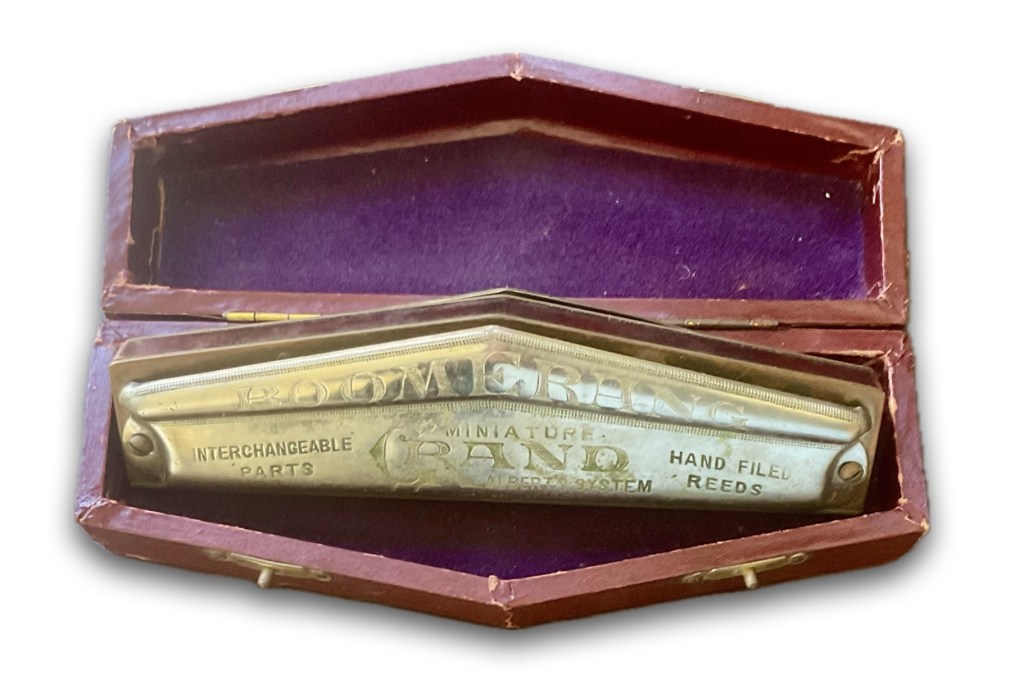
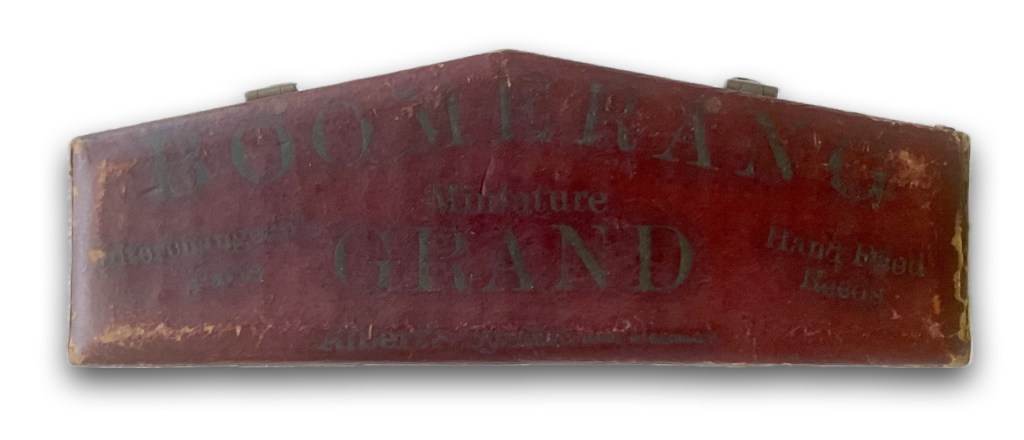
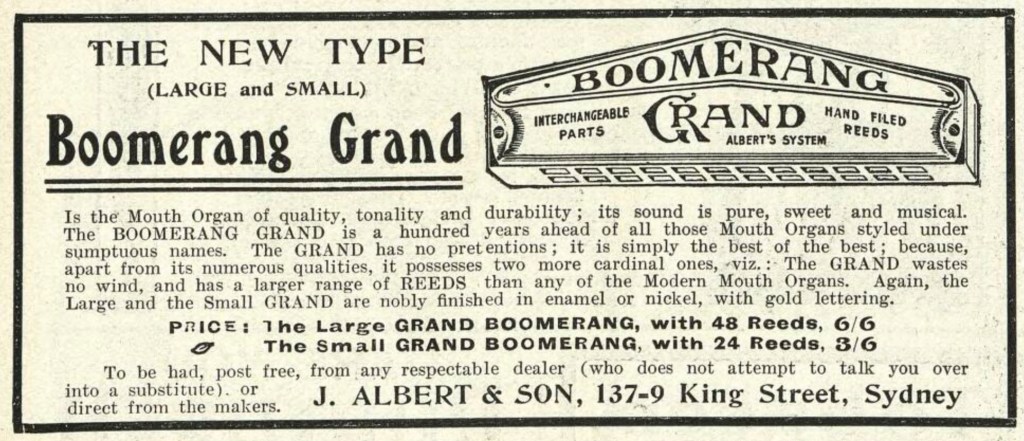
The latest inclusion to the Shep museum is this ripper specimen, the Boomerang Miniature Grand. Made by the oldest current mouth organ factory in the world Seydel in Klingenthal, Germany for Albert & Son in Sydney, Australia. This is possibly an antique (or close to) model.
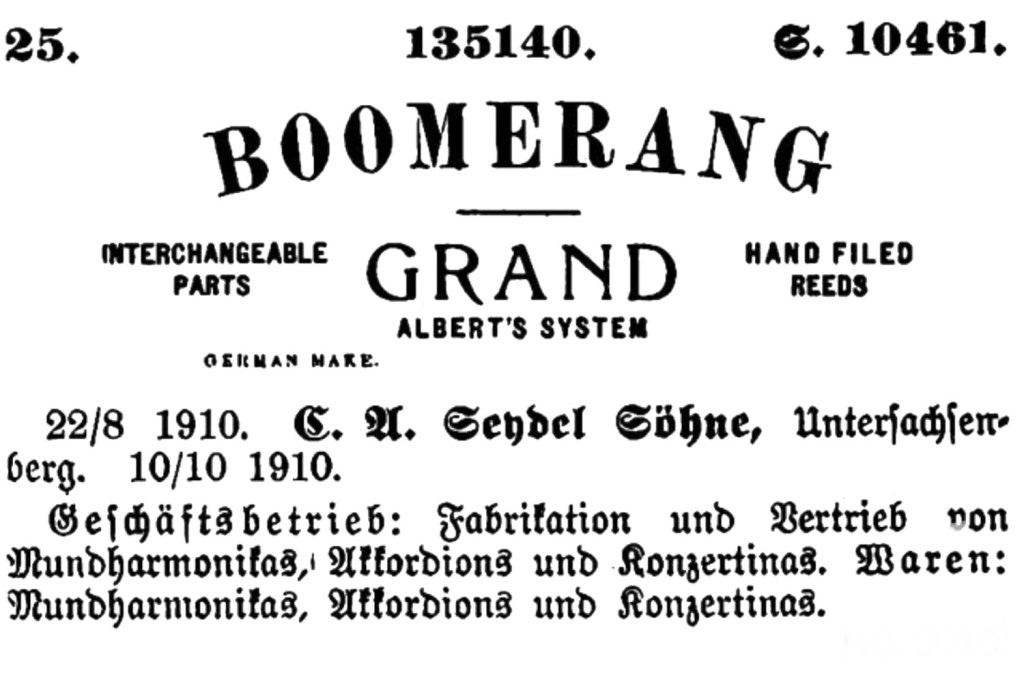
Trademarked in 1910, but it wasn’t until the following year that it was advertised in the newspapers.
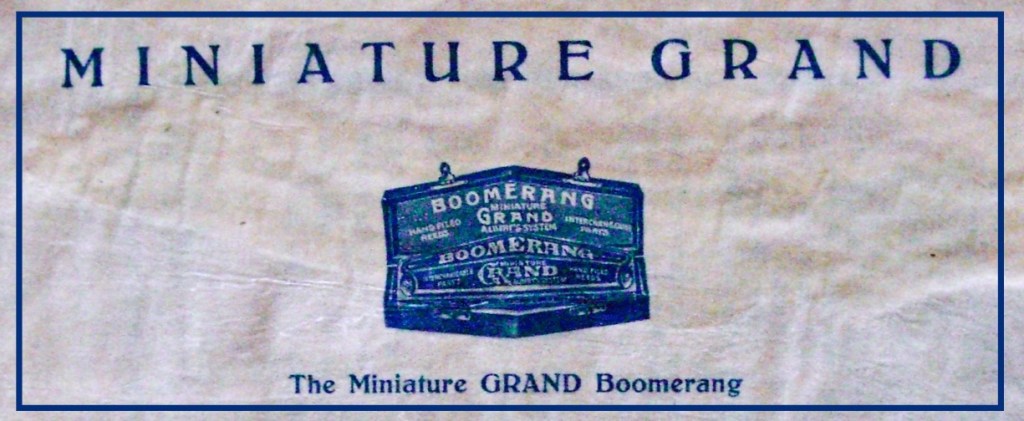

Early Advertising
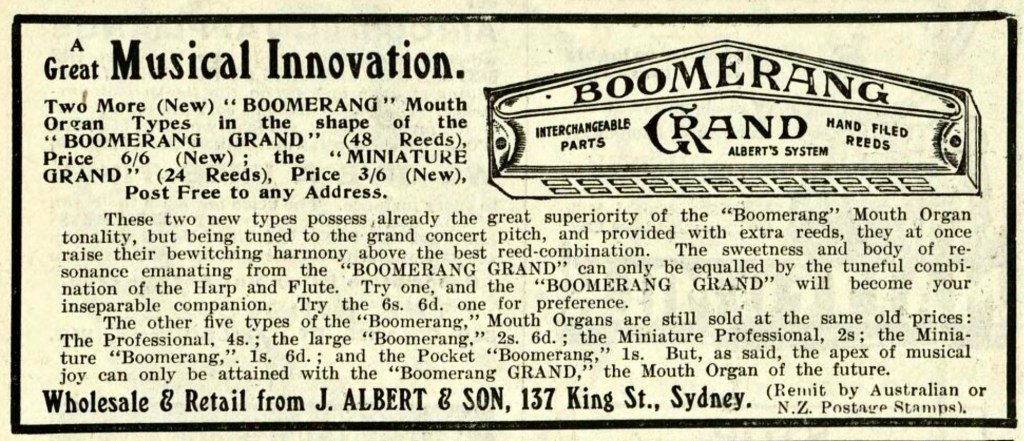
It certainly has a couple of extra holes that could be beneficial and I wouldn’t think there were too many twelve hole vampers available then (long time before Sonny Boy Williamson II performing Bye Bye Bird on a twelve hole Echo Vamper). But what about the claim of being tuned to ‘Grand Concert Pitch’? Well that certainly took me down a rabbit hole of equal temperament, just intonation and compromise tunings. I’ll hand over to our expert Pat Missin for his take on this.
I am not aware of anything officially called “Grand Concert Pitch”, so at the risk of sounding cynical, my first guess would be that the term is as meaningful as “Albert’s System” etc.
My (slightly less cynical) second guess would be that perhaps they are referring to tuning to A=440Hz, rather than “Continental Pitch”, which was A=435Hz. That said, 440 didn’t become standard until some time later, so it could be referring to one of the other tuning standards that were in use back then. Or it could be my first guess!
Aussie Pitch
Concert Pitch by V. De Giorgio
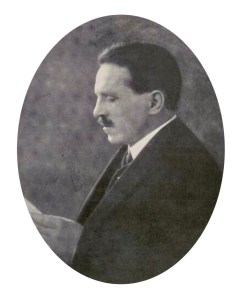
Signor V. de Giorgio, well-known teacher of
singing and piano
I find myself at a loss to explain why it is that the musical people of of Australia, who take such a great interest in the development of our art, have neglected till now to solve and settle this important question of pitch. It is known that the concert pitch used here is a good half-tone higher than the European or Continental (435). What is the reason for retaining this pitch? (The Sydney Morning Herald, Sat 17 Apr 1909)
I located an advertisement (above) that implied we had an Aussie Pitch higher than Continental. Pat responded to the article thus. “There was a lot of competition between the different tuning standards back then. Higher pitches were claimed to sound brighter and livelier, lower pitches were supposed to be easier on singers and stringed instruments, but I am more than a little skeptical that the difference between 435 and 440 would be enough to be really noticeable. Well, unless you had two different tuned instruments playing together.” Furthermore Pat suggested that he thought, “they were basically advertising the fact that these harps weren’t going to be in tune with any others! In fact they would sound like a swarm of angry hornets.”
Chain
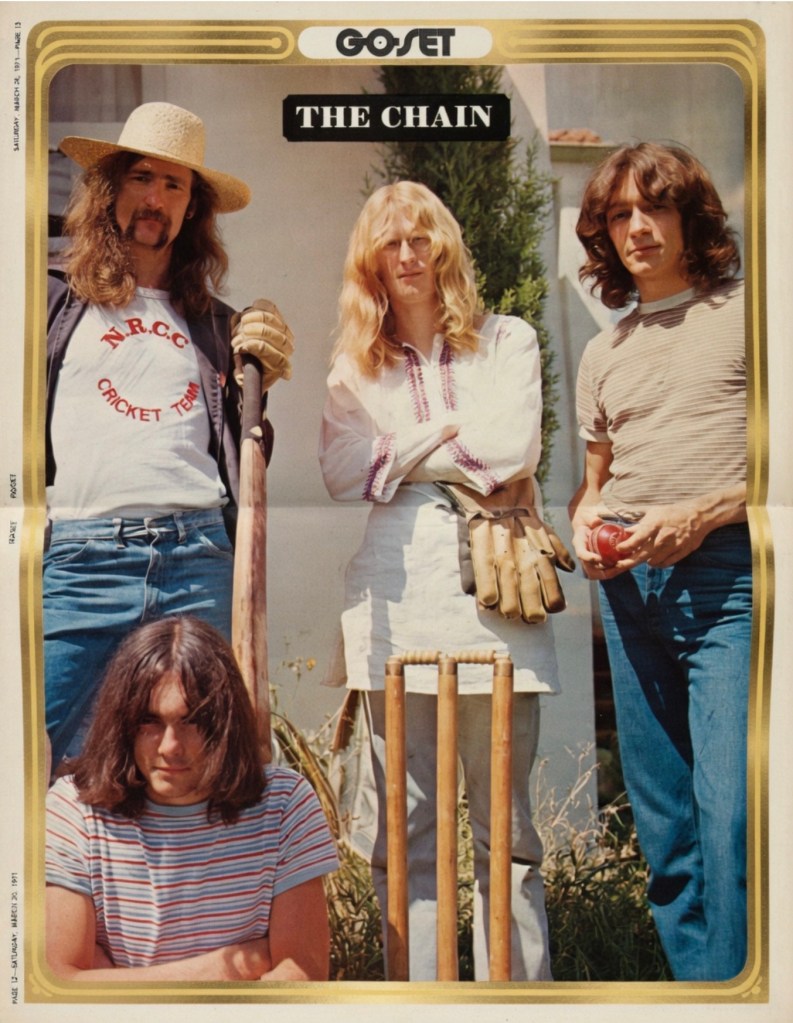
Reminds me of a tale that Matt Taylor (Chain) related to me about the punters who would bring along harmonicas and jam with Matt and the lads at gigs in the early seventies. When the band took it down, there was an awful racket rising from the floor as many harmonicas weren’t in the appropriate key!
When my Boomerang Miniature Grand arrived I exhaled (certainly wasn’t going to inhale) a little air through the fourth hole and sent it as an audiophile to the Guru. And he was on the money with his original observation, “That is a G that is very slightly flat of an equal tempered G relative to A=440. It’s certainly much closer to 440 than 435.”
I’m certainly happy that I can blow a Hohner Special 20 straight out of the box to play live with a band, or in a recording session, without any pitch issues. I had a chat with Steve Williams, and he too never had an issue with a Special 20 when performing with John Farnham, and he added, “all reed instruments have tuning discrepancies derived from air pressure…the harder you play a sax reed the flatter it sounds, the lighter you blow, the sharper…same for harps…but when you get down to it Big and Little Walter, and Butterfield and everyone else just bought a harp and played it”.
Boomerang Shaped?
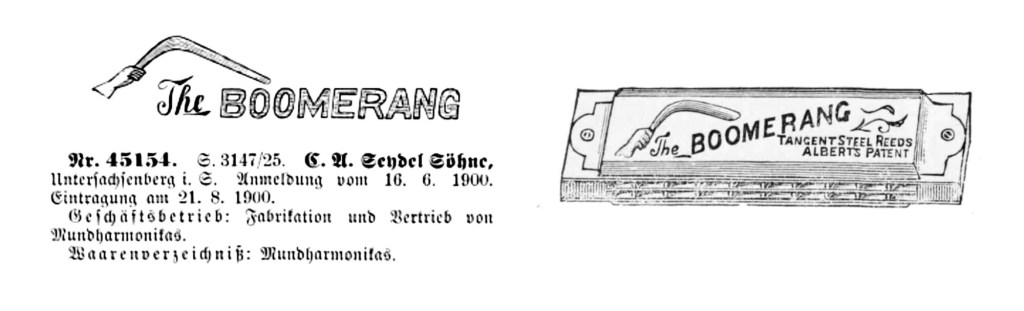
Albert’s mouth organ brand logo was a hand holding a boomerang and was stamped on both their top sellers of the time their standard 20 reed and 40 reed models.
There is a suggestion that the Grand is boomerang shaped. I would contend the top portion of the cover plate certainly is, but not the harmonica. It perhaps was the prototype and inspiration for the actual boomerang shaped mouth organ (the De Luxe) that was produced in 1925 and as I’ve recently discovered played by Pete Hasson when winning the Wonthaggi Boomerang competition of the same year.
Black Enamel
The Bulletin Vol.32 No. 1660 (7th December 1911)
Later in 1911, a black enamelled Grand with gold lettering was in production for a couple of years. I have never seen one in the flesh. I was also of the belief the 1925 De Luxe model (the boomerang shaped) had been manufactured in black enamel too!

Seydel Sun Brand
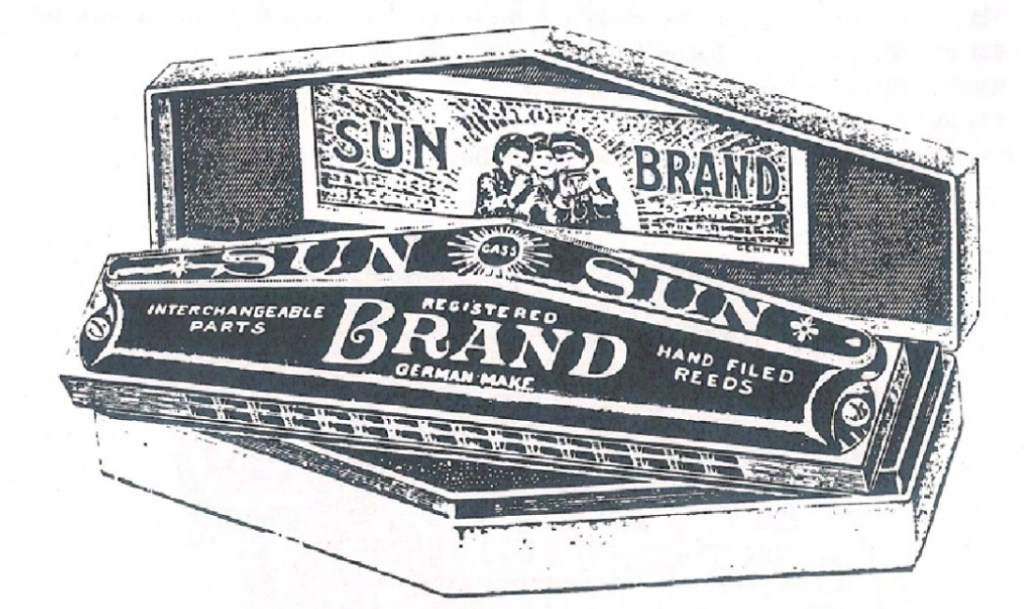
Seydel also later produced models with the same shape as the Boomerang Grand, the Sun Brand and Ragtime Band produced for B S Dulcet in London.
Sub Offices

The Australian Worker, 8 Aug 1923
Just for interest sake, when researching an advertisement for the Grand, I noticed J. Albert & Son had a Melbourne office at 294 – 298 Little Collins Street.
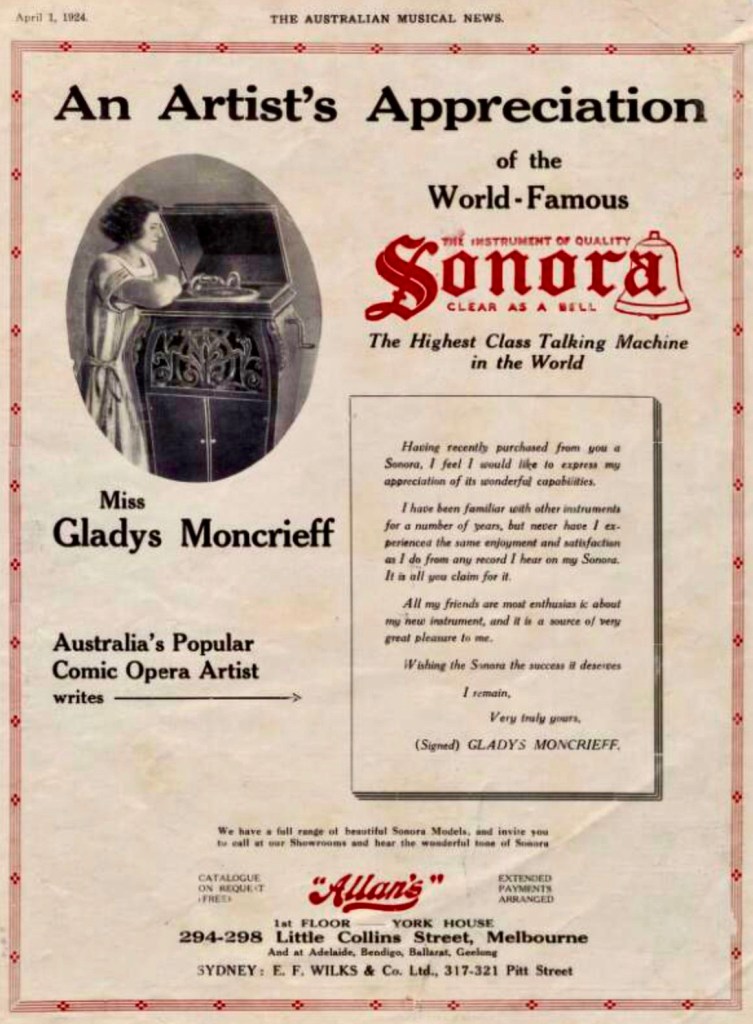


I knew I had viewed an advertisement for Allan’s at the same location (a sub branch) just one year later and it was signed as Sonora House. I believe it was so named because Allan’s vended the Sonora Talking Machine. Allan’s main dig was located nearby at 276 Collins Street. Albert’s was interstate, Boomerang House in Sydney at 137 – 139 King Street.
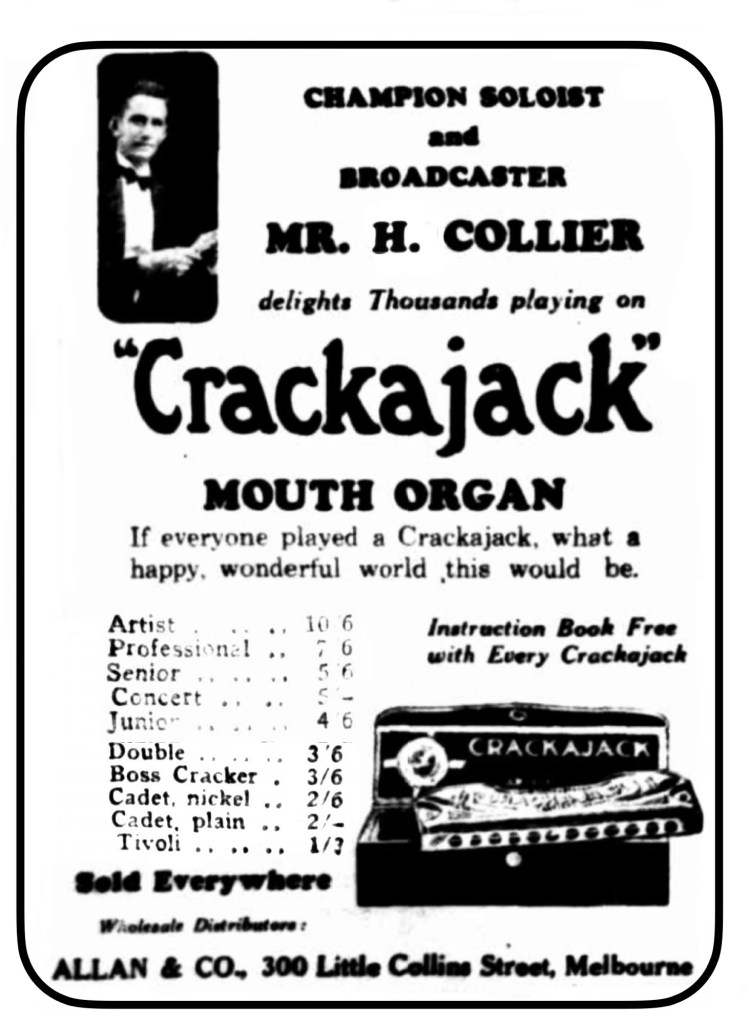
Sporting Globe, Wednesday 30 October 1929
In 1929, Allan’s also occupied the building next door to Sonora House at York House (300 Little Collins Street), selling the F A Rauner Crackajacks in direct opposition to Seydel’s Boomerangs. I think Albert’s had a Melbourne branch from about 1923 – 1933 .

Please check home page for copyright details.
 Harmonica Riff Raff
Sonny Boy Williamson ll. What a technique. And at the end with no hands. Loved watching that video. Great read as always Shep. Pitch info was interesting. It also made me think of recorded music. My brother Steve was trying to play guitar over old cassette tape playback listening to learn old songs of mine. He said it wasn’t in the key I told him. Slightly out. Something to do with tape speed and the machines playing them.
The new guitar and other instrument digital tuners nowadays can be changed to suit pitch needs. They come with little instruction manuals. So guitars, etc. could be changed to suit fixed harmonica/harp pitch. It is just those playing styles and techniques, as you say, that may send the harp into a different pitch sound territory. I still have my little pitch pipe 6 note bank with the metal reeds from the 1970s. Surprisingly, still pretty accurate when comparing with the digital one. Mind you my ears have gone AWOL tuning wise. Frequency loss in old age is a pain.
Cheers Shep. Hope all is fine and going well for you. 🥃🥃
LikeLiked by 1 person
True, and apparently singing out of tune live anymore isn’t a problem thanks to technology. Cheers for your peepers and thoughts Gray. A bourbon to you mate. 🥃🥃
LikeLiked by 1 person
Singing out of tune is something I can’t hear for myself when singing. As said, my frequencies are a bit shot. I just hit the tunes I write in my head and go with them. When they hit the red sound button to record and then happen for all to hear out in the open, it’s past manipulation. If they are suspect, I don’t worry. But auto tune is out of the question. I read about this new way of ‘perfection’ as a new development and I have seen analysis on YouTube. The ‘Wings of Pegasus’ guy on YouTube really does analyse it and deep dive well. He is pretty scathing. And Justin Hawkins from The Darkness, again on YouTube, can spot a naturally sung sharp/flat inflection or manipulated auto tune on a voice a mile off. Most of the music we have both listened to over the decades has odd voice synergy with the instruments. All the better for it. But that is music in all its glory. The Sex Pistols, after decades of listening, settle into the mind as absolute game changers.
Drinking Woodsman whiskey tonight Shep. As I type this. A nice little caramelised feel to it. 😊 Cheers 🥃🥃
LikeLiked by 1 person
I probably should state I am a nay for auto tune – dead set against. Agree totally with you. Sounds like I’m having a Woodsman with you 🥃🥃
LikeLiked by 1 person
The listening ear is a forgiving one. I kind of adapt my brain to songs heard. The overall synergy is what truly hits home. Of course, totally out of tune stuff is not this scenario. But, subtle emotional changes in a song are essential. They add to the emotions. Why am I thinking Tom Waits here. Or Lee Marvin’s Wandering Star. Lower keys hitting heart strings maybe. I reckon a few bourbons out in the open air under a dry night sky and an adopting of a growler vocal may be a decent experiment. Sung in the key of E of course. 😊
🥃🥃 ? I’m thinking should I have another 🥃 which maybe tips me over the edge into growler country by pouring a generous triple measure. Tomorrow is the weekend after all.
Cheers Shep. Always appreciated.
LikeLiked by 1 person