

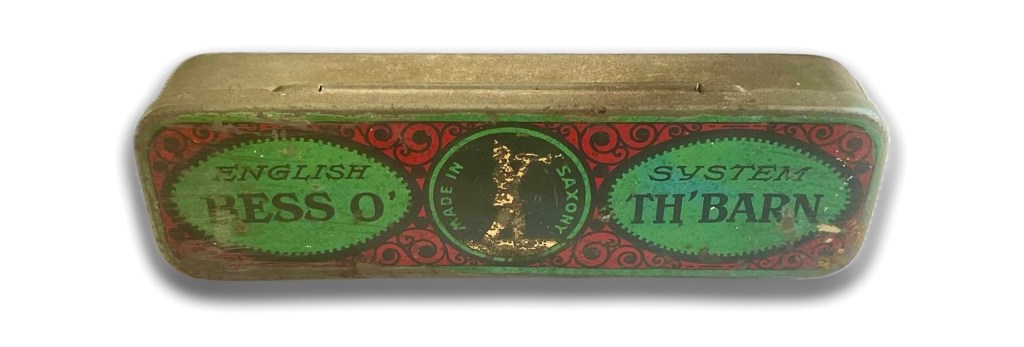
A new selection for the collection joining the Cobber & Boomerang tins. Pretty chuffed to have quested this Bess O’ Th’ Barn metal case from Lakes Entrance. I haven’t witnessed too many of these rising to the surface in my ten or so years of collecting for my collection.
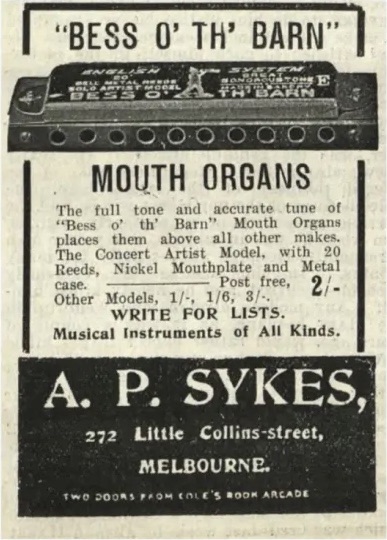
First sold in 1913 by Alfred Percy Sykes of 272 Little Collins Street Melbourne. Three models were on offer; the Solo Artist (20 reeds), Concert Artist (20 reeds, but with a nickel mouth plate) and the Professional Artist (40 reeds and nickel mouth piece). They disappeared from the market during the Great War and didn’t return for quite sometime after.
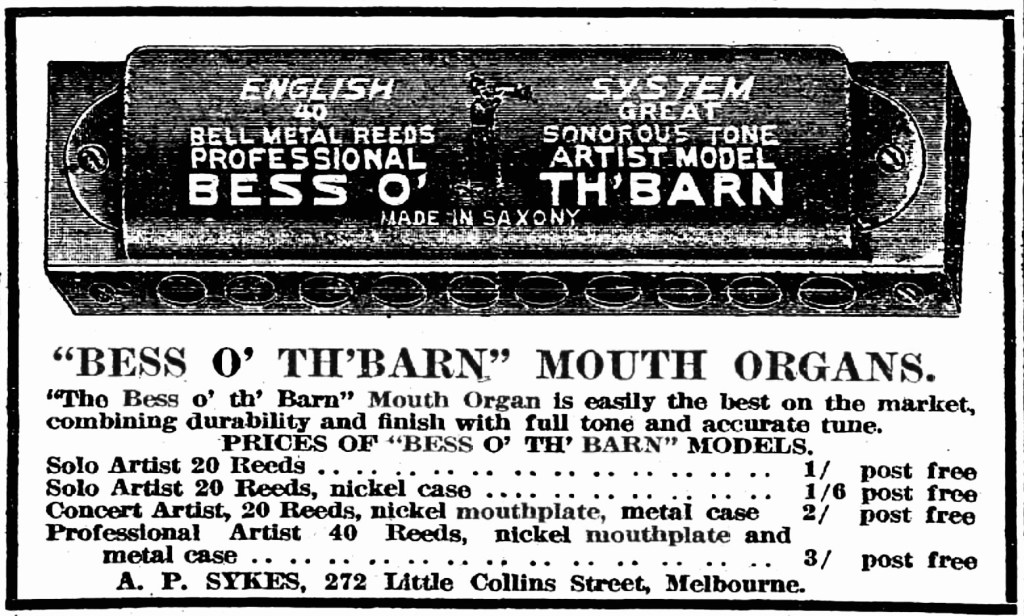
Weekly Times (Melbourne, Vic.) 4 October 1913
MELBOURNE ARRIVAL OF THE BESSES O’ TH BARN BAND
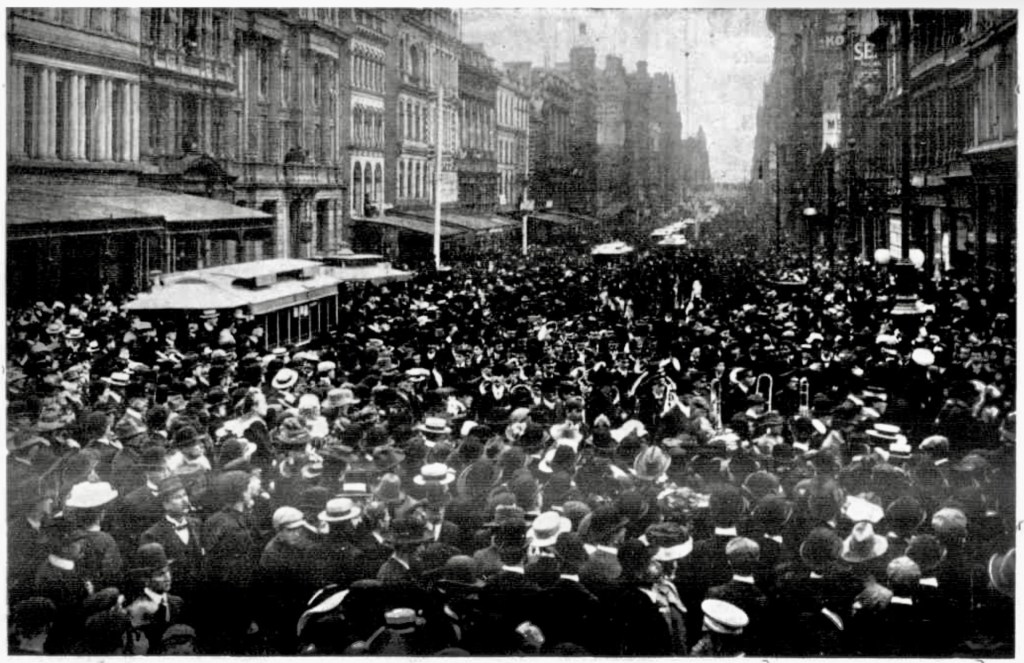
Branded after a brass band, who hailed from the whimsically named suburb Besses O’ Th’ Barn in Bury, Manchester – except singular for some obscure reason. The band formed in 1818 and they visited our sunny shores in 1907 thanks to the efforts of Charles Tait of Allan’s. They arrived in Melbourne to epic, beatlesque scenes. They would also ‘get back’ again a few years later.
BESSES O’ TH’ BARN BAND – AMERICAN, NEW ZEALAND & AUSTRALIAN TOUR, 1906 – 1907.
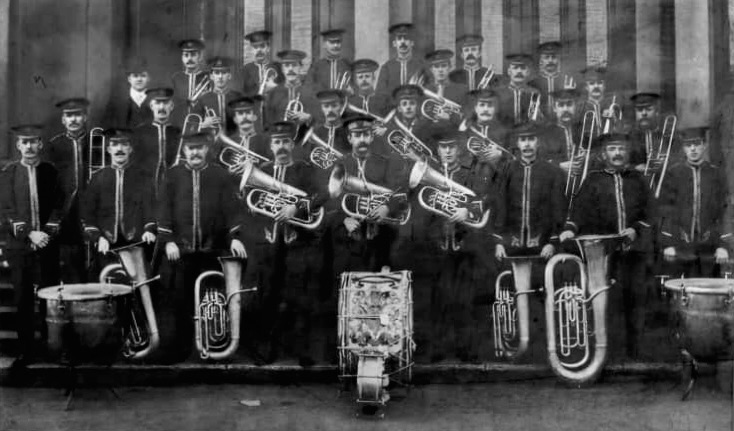
2nd Back: C. Tait (Allan’s), J. Bowden, S.Potts, J. Hilton, R Ball, W. Jackson,
N. Rilly.
2nd Front: T. Bowling, T. Wolstencroft, A. Bleakley, W. Bogle, S. Hollingworth , W. Brearley, W. Scottron , W. Lawson.
Front Row: S. Massey, J. Fish, S. Lord. R. Kay. J. Berry, J. Hewitson, J.W. Smith, E. Bleakley, G. Fielding.
Charles Tait managed to photo bomb himself into the team shot. For more on Charles head to A Crackajack Story. It might have been difficult for Allan & Co to produce a Bess O’ Th’ Barn mouth organ as this would be in direct competition to their famous Crackajack Brand. Perhaps they could have marketed a Bess O’ Th’ Cracker? A P Sykes took full advantage of the opportunity and with Otto Weidlich onboard the rest, folks, is history.
From my research it appears their namesake mouth organs were produced solely for the Aussie market on the back of their popularity ‘Down Under’, and were not sold in the UK.
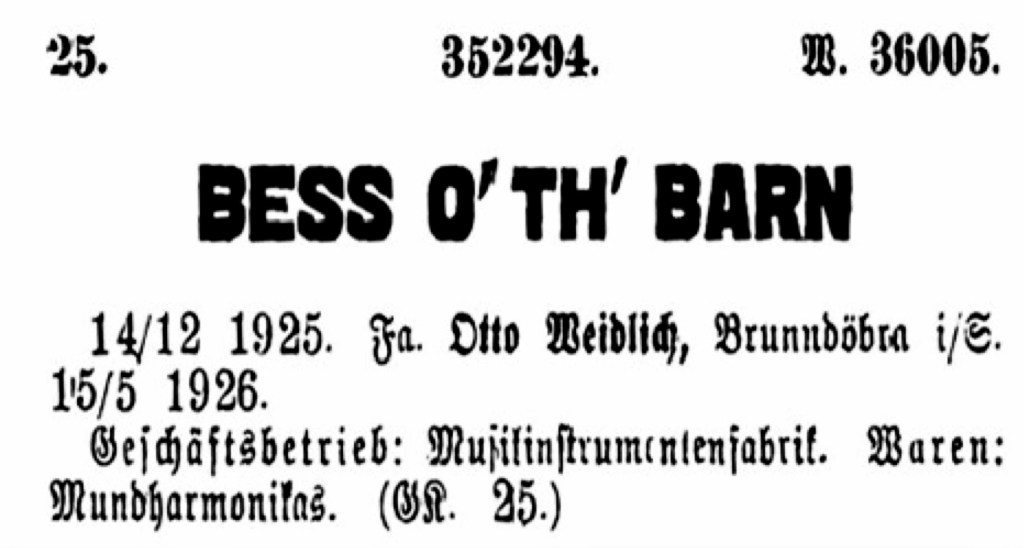
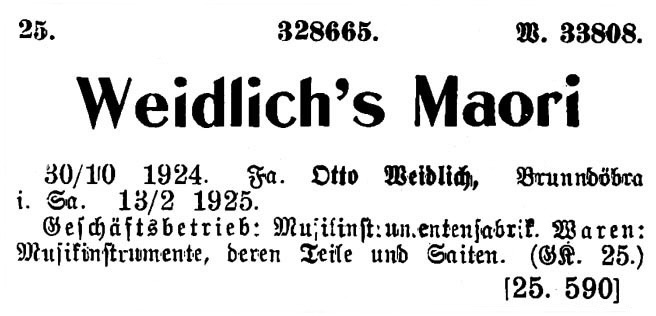
They had another run after WWI with Otto Weidlich trademarking the name, likely for the second time in 1925. The Professional Artist model was updated to include wind savers and the Miniature Concert appears to be a new model.
FITZROY FESTIVAL
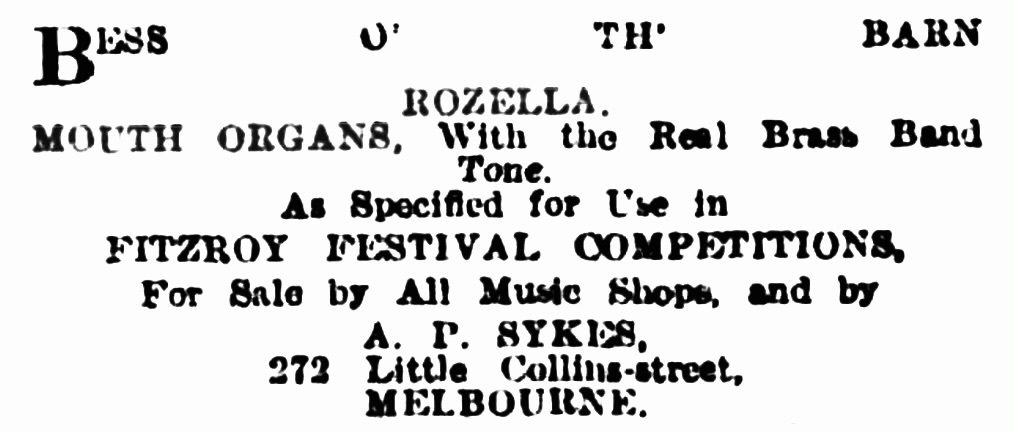
Fitzroy Festival Competition Results (The Age Friday 19 November 1926) Mouth Organ Contest (First Part): Mr. Collier, Collingwood, 1; J. J. Maygar, North Fitzroy, 2; W. Green, Melbourne, 3. Mouth Organ Contest (Second Part) : T. Moyle, North Fitzroy, 1; Mr. Collier, Colllngwood, 2; J. J. Maygar North Fitzroy, 3.
We were informed through an A. P. Sykes advertisement, that Bess O’ Th’ Barn and Rozella mouth organs were specified for use in the Fitzroy Festival Mouth Organ contest. It certainly wasn’t exclusively. Albert’s of Melbourne were quick to point this out, after the event, in an advertisement published in the Melbourne Sun News-Pictorial on the 27th of November, 1926. They declared that T. Moyle, T. Wilson and J. J. Maygar had used their Boomerang mouth organs. One would assume that Mr. Collier was Harold Collier, a Crackajack Mouth Organ exponent. Not so sure why his name is so formal when all the other contestants have just an initial. That would only leave W. Green of the place getters that might have used a Bess.
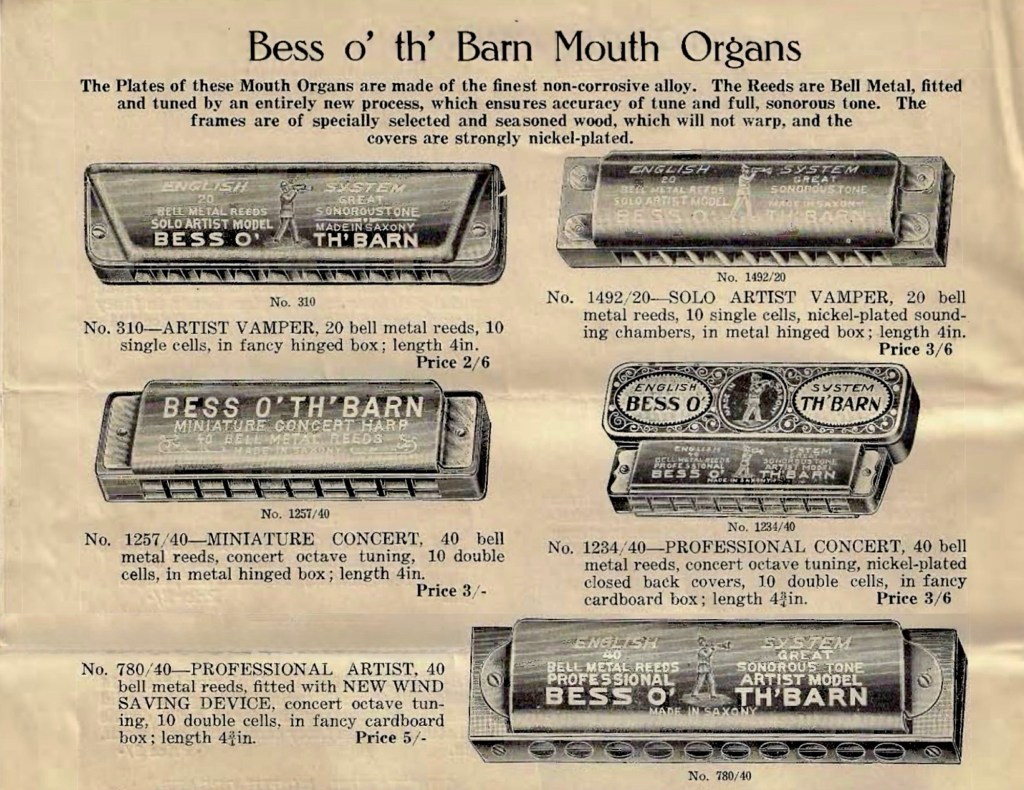
I’m thinking on the evidence presented by the prosecution, that my tin could be a pre WWI tin, probably associated with the 40 Reed Professional Artist model of 1913 (advertised with a metal case). The tin is quite long at about 13 cm – just over 5 inches long and is comparable to the Boomerang tin that housed their similar 40 reed Professional model.
If it was later, the metal case would be too long for the models advertised with tins – both the Solo Artist Vamper and the Miniature Concert measure four inches. The same Professional Artist model, with the 10 round double cells, is said to have a fancy cardboard box.
That said, the Professional Concert model pictured has Professional Artist on the cover plate and appears to be associated with a tin, even though the blurb states this arrives in a fancy cardboard box.
You know it makes sense!
There is also documentation of the Professional Artist (with wind savers) being in existence as late as 1936.
Weidlich’s ‘English System’
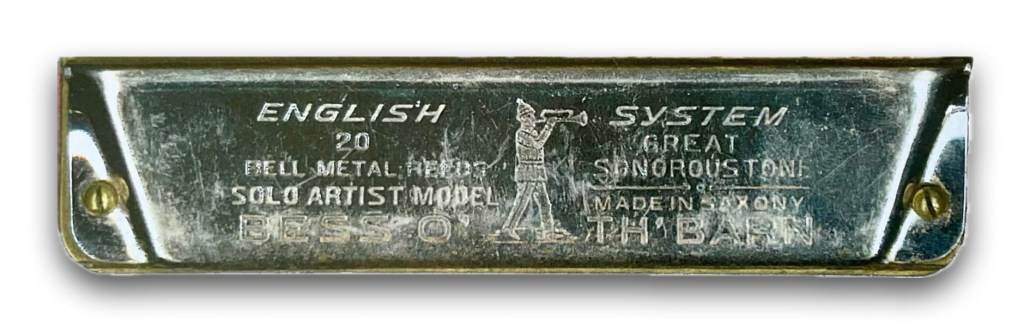
We know beyond reasonable doubt that the early Bess ‘O Th’ Barn models were Weidlich’s as the Rozella Mouth Organ, trademarked by him in 1912, also had the unique cover plate stamping of ‘English System’. The Pied Piper, too was stamped ‘English System’.
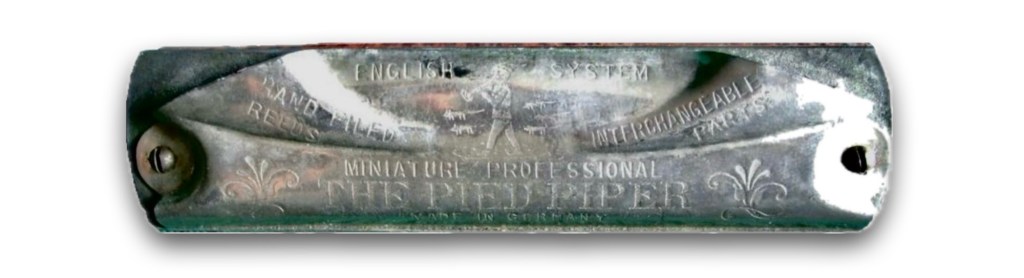
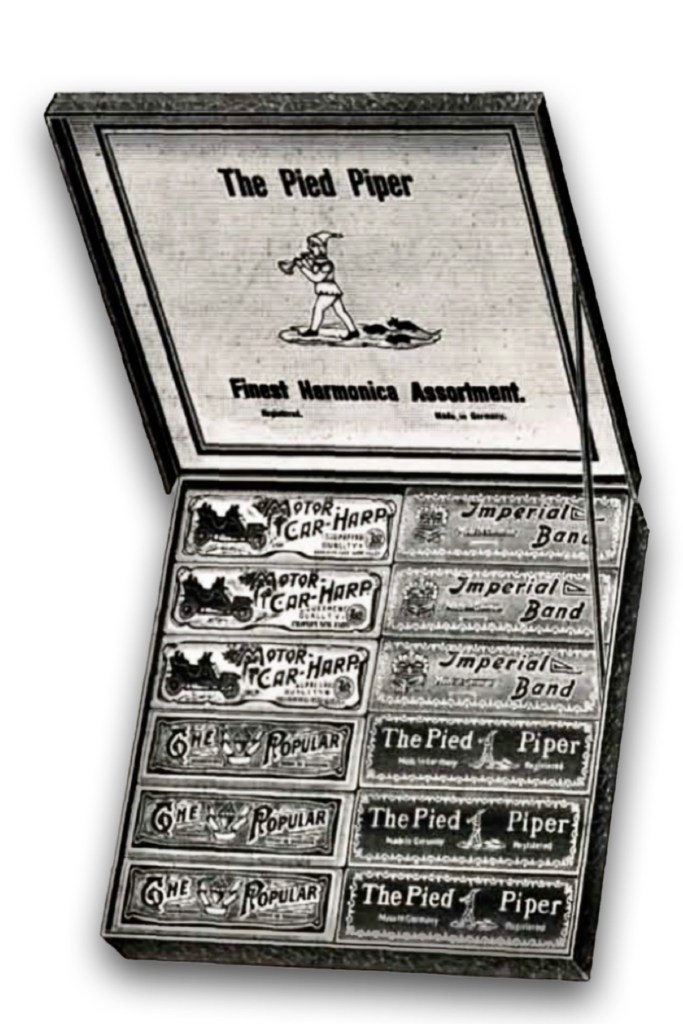
Check out an earlier article Besses & Beatles for more details on the Bess O’ Th’ Barn and its curious spelling.
Y the Z
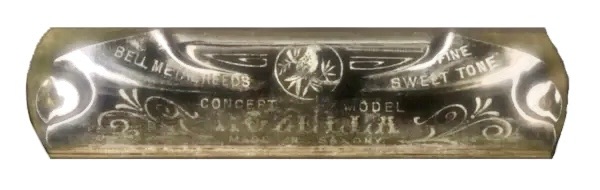
Quite a few years ago I was the underbidder on this Rozella. It went a little too high for me at the time.
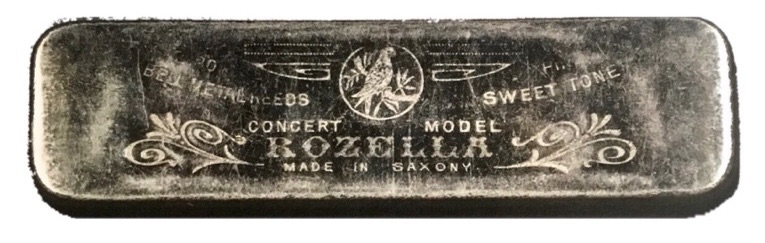
It had its metal case, but appeared stripped of any colour. I haven’t espied another one since.
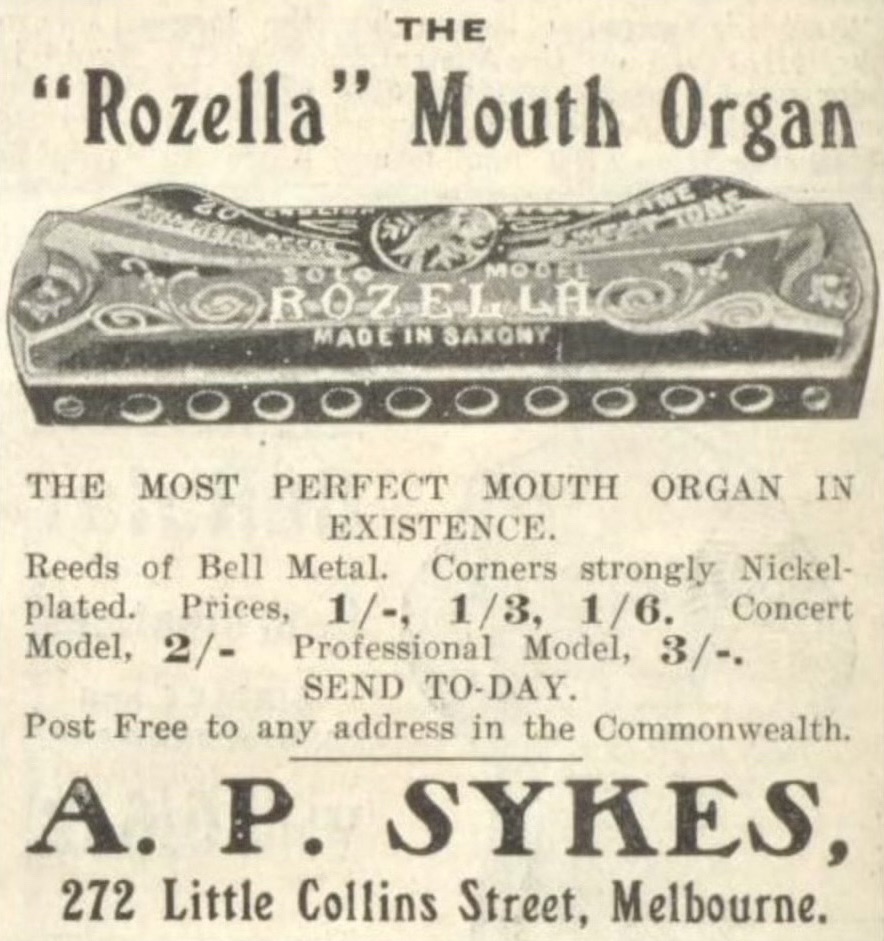
The Bulletin – Advertised 1913
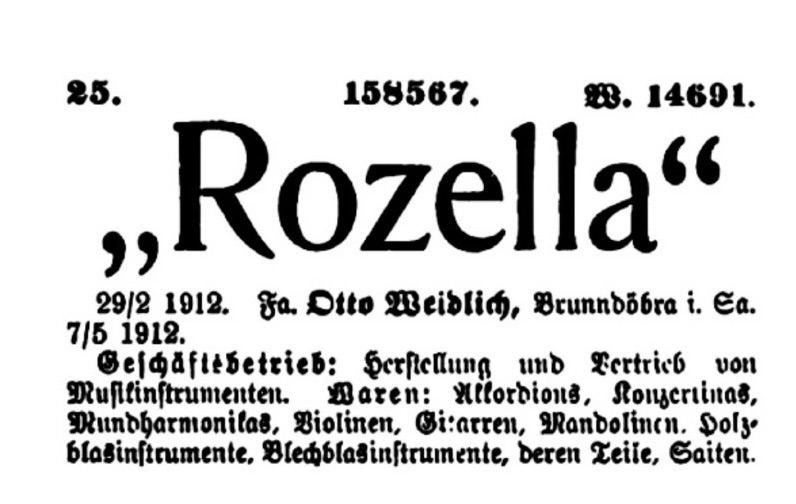
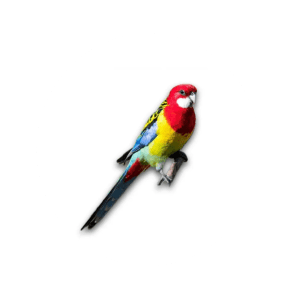
And speaking of curious spelling by Weidlich, his Rozella has a ‘z’. They were named after our native parrots, which is spelt Rosella, with an ‘s’. There are six main species of Rosella; the Crimson, Eastern, Western, Northern, Pale – headed and Green.
My original thought for the different spelling was A P Sykes didn’t want to be in conflict with our famous brand of soups and sauces.
Unrivalled & Australian
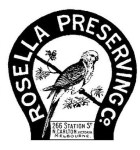
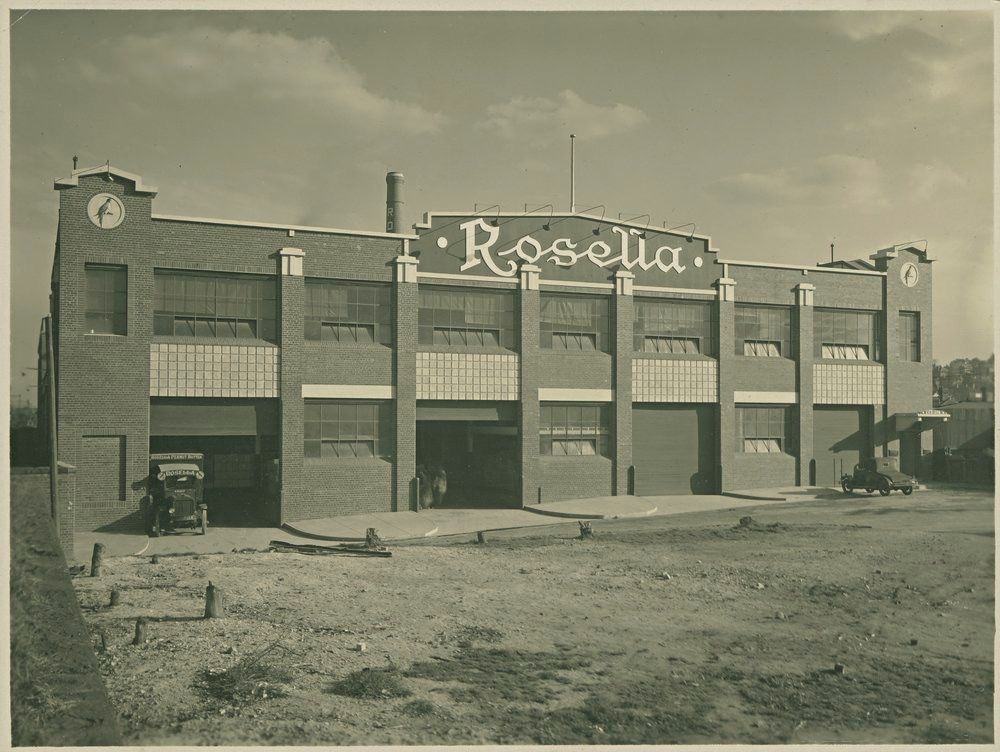
The Rosella company came to fruition in 1895 in a North Carlton backyard by two friends, H. R. McCracken and T. J. Press. Initially a fruit preservation business, it expanded quickly on the back of their iconic tomato sauce (first produced in 1899), to them then opening their Richmond factory in 1905.
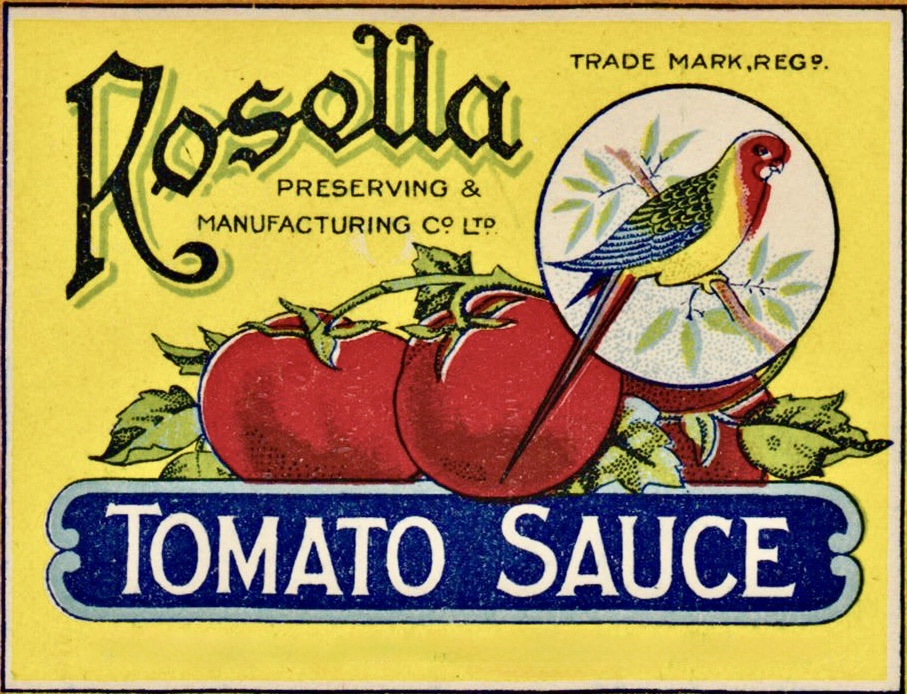
1920’s Label
However, I’m now thunkin’ it was due to the fact that Hohner had already trademarked Rosella with the ‘s’ in 1900.
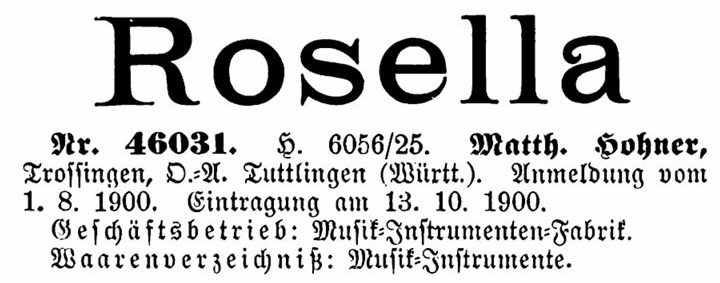
A big thanks to Pat Missin on his mission of locating these trademarks and this one as well by Otto from over the ditch.
Please check home page for copyright details
 Harmonica Riff Raff
Love old tins Shep. That’s a beauty. I like to house vintage pen dip nibs in them. That crowd is phenomenal in number. Liked the Ol’ Shep Get Back humour here too. Product names? It reminds me of band names that resurface after decades. I have a couple of CDs by the original 1960s psychedelic band called Nirvana. Or, American spelling of using Z instead of S or dropping out letters in words like colour to color. I wonder if you could get away with how you spell a name legally. Cheers for the interesting read again Shep. Hope you are keeping fine. All the best.
LikeLiked by 1 person
You’re not having it! 😜 Only gagging. Nothing quite like collecting relics from the past. Cheers for your peepers Gray.
LikeLiked by 1 person
😊 I have more of the medicinal kind Shep. Gee’s Linctus Pastilles B.P.C is a fave for some odd reason. Some are quite tiny too. Paludrine Hydrochloride is one I keep a few plectrums in. Modern tins have some nice designs too. I’ve got my Vocalzone tablets in their modern promotional tin. If I use one from the tin, instead of the blister pack….my voice sounds like an angel. 🤣. Tom Jones swears by Vocalzone.
Some of the dip nibs I bought off eBay were housed in their original little cute cardboard boxes. And I have a fair few original fountain pen housing boxes and tins too. I just keep them empty in a big shoe box. The pens are in constant use, so are all in grab-able leather or canvas cases/wallets that can take a few sitting next to each other. I think I have seen someone wearing a harp ‘sling around’ strap like that. Lines of ‘grab at’ harps for playing live. Maybe I’m wrong.
Boxes and tins hey! Strange little addictive beasties. Cheers back at you Shep.
LikeLiked by 1 person